

Every chess tactics trainer looks the same from the outside. A position appears, you play a move, you get a tick or a cross, a number moves up or down. Millions of us do this every day, on the bus, in bed, in the four minutes before a meeting. And a large share of those people have been doing it for years without getting measurably better.
The trainer is rarely the problem. The way it gets used almost always is.
I went from around 2300 to nearly 2600 with tactics as the backbone of my training, and later spent two years building one of these things, which means I have stared at the failure modes from both sides. So here is what a tactics trainer is actually for, what its rating does and does not tell you, and the routine I would give a student on day one.
What a chess tactics trainer actually is
The puzzles are not the product. Anyone can scrape a million positions where somebody blundered a rook.
The trainer is the machinery around them: a rating on every position, a rating on you, a selector that matches the two, theme tags so you can drill one idea in isolation, and some way of telling you why the move you played loses. Strip those out and you have a puzzle book, which is a fine thing but a different thing. A book of 1,000 puzzles does not know that puzzle 340 is four hundred points too easy for you.
The name itself is a bit of chess history. Trainers of this kind arrived in the mid-2000s, most of them have since rebranded their puzzle sections at least once, and the phrase “tactics trainer” stuck anyway, because it describes the machine rather than the marketing. It is still what most players type when they want one.
What your tactics rating actually measures
Every serious trainer runs an Elo-style or Glicko-style rating. Each position carries a number, you carry a number, and solving a 1600 puzzle when you are rated 1500 moves yours up more than solving a 1200 one does.
That number measures one narrow skill: finding the answer in a position where somebody has already told you an answer exists. That is not nothing. It is also not your playing strength.
Two consequences follow, and both matter.
Ratings do not transfer. The same player in the same week can sit near 2600 on one trainer and several hundred points lower on another, because the solver pools and the scaling are different. Even the trainers that have studied how their numbers line up against a real FIDE rating ship a disclaimer alongside the finding, which tells you how loose that relationship is. Comparing your number to a friend’s on a different platform is a conversation about nothing.
And the number is a thermometer, not the medicine. It tells you whether the training is working. It does not do the training. I have written more on what a puzzle rating means and how to read it, because this is where most people’s tactics work quietly goes wrong.
Four modes, and only two of them are training
Open any modern tactics trainer and you get a menu. They are not equivalent.
Rated solving, one position at a time with no clock breathing on you, is the core. This is where calculation gets built, because you are allowed to take ninety seconds on a position that deserves ninety seconds.
Themed drilling is the most under-used feature in the whole category. Fifty deflection puzzles in a row teach you deflection. Fifty random puzzles teach you that tactics exist. If your last twenty losses came from missing discovered attacks, the fix is not “more puzzles”, it is three sessions of nothing but discovered attacks.
Race and streak modes, where you solve against a clock until you fail, are a fitness test. Genuinely useful once a week as a measurement, and good fun, but nobody has ever learned a new pattern in the four seconds one of those positions gets. Treat them as the weigh-in, not the gym.
Endless unrated solving is a warm-up. Fine for a train journey when your brain is fried. Not a session.
How to use a tactics trainer so that it works
Set the difficulty so you fail. Not constantly, but regularly: somewhere around three in four correct is the zone where you are still solving things but genuinely working. If you are at 95 percent you are revising. If you are at 40 percent you are guessing and calling it study.
Then calculate to the end before you touch a piece.
 8
8 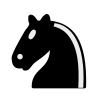

 7
7 

 4 3 c e
  g
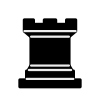
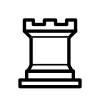
g Here White plays 1.Qxh7+, the king takes, and 2.Rh4 is mate on the h-file. Most trainers award you the point the moment you enter Qxh7. That is the trap. You can be rewarded for a move you played on a hunch, and a hunch that gets a green tick is a habit you have just reinforced. Say the whole line out loud, or at least name the mating square, before you move. In a real game there is no green tick to tell you the sacrifice works.
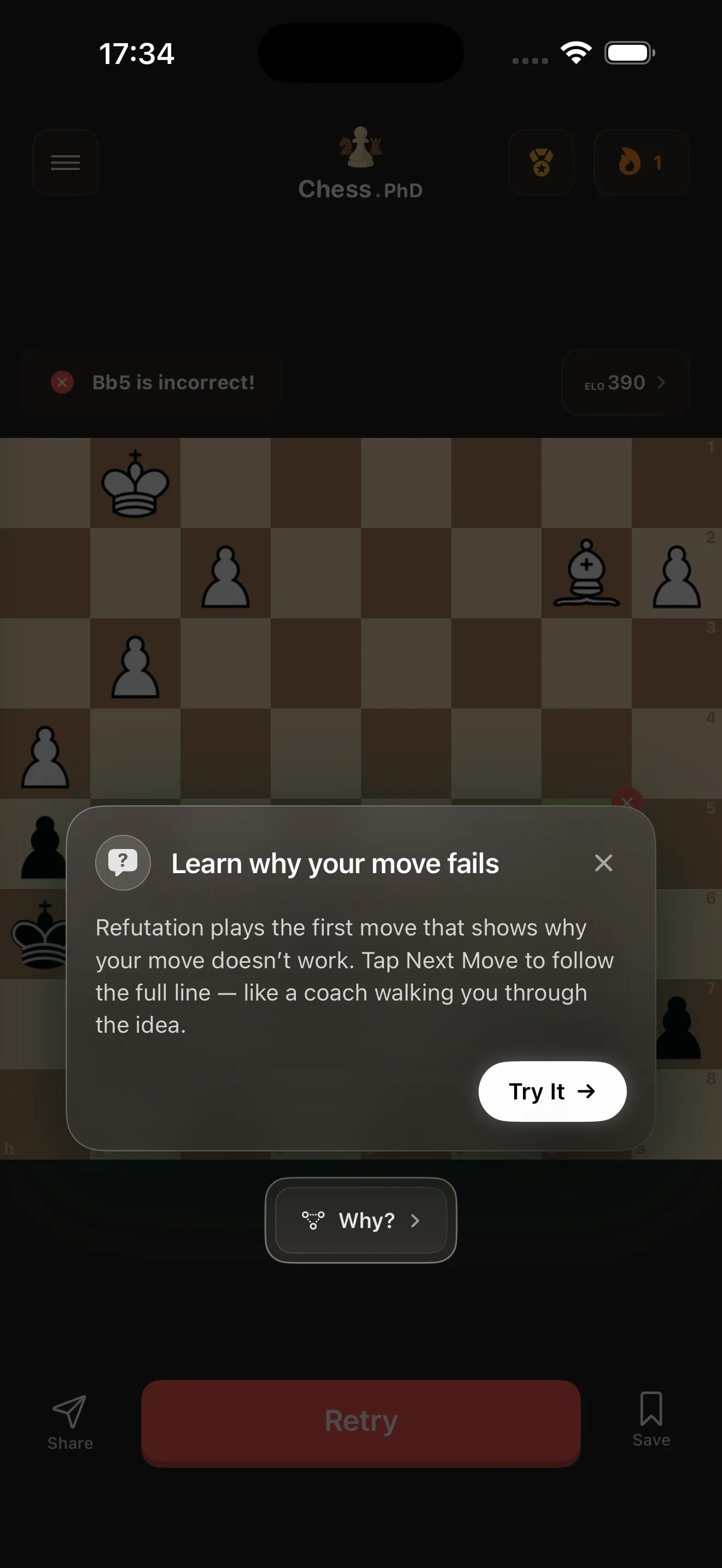
Read the refutation on every single miss.
7 2 d g Black gives up a rook with 1…Re1+ so that after 2.Rxe1 the d1-rook is no longer guarding d5, and 2…Qxd5 collects the queen. Solve that one and you learn a little. Fail it, then work out exactly which defender you forgot about, and you learn considerably more. The miss carries the information. Skipping past it to the next position is like paying for a lesson and walking out before the coach speaks.
Repeat your sets. Pattern recognition is built by seeing the same shape until it stops being a puzzle and starts being obvious, which is the whole idea behind the Woodpecker Method. Cycling one set of 200 positions four times will do more for you than 800 fresh ones you will never see again.
Keep the daily volume boring. Ten to thirty positions, properly calculated, most days. I went into the numbers in how many chess puzzles a day, and the short version is that the people who improve are not the ones with the biggest daily count.
What separates a good tactics trainer from a bad one
Four things, and the rest is decoration.
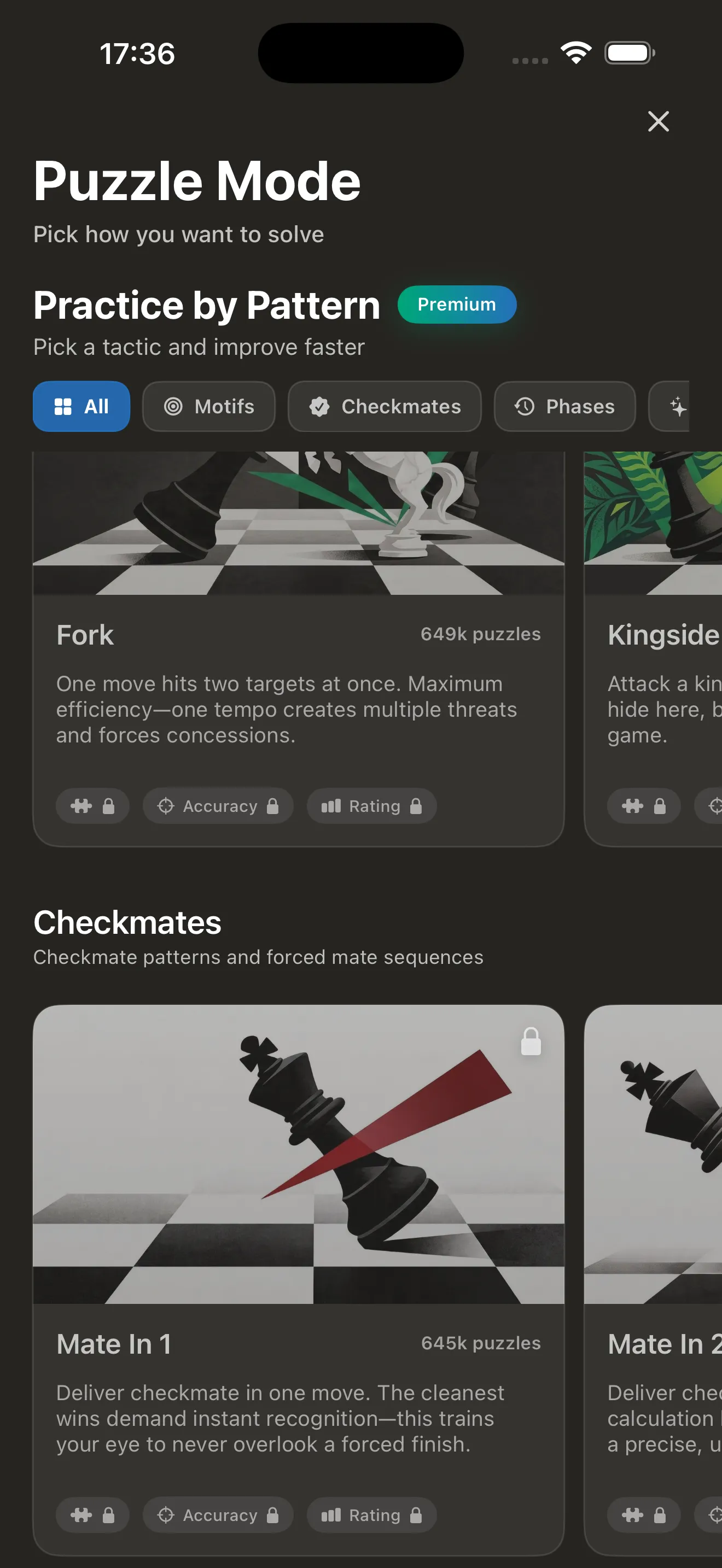
Depth of library at your exact level, so the selector is not scraping the barrel and repeating positions you saw on Tuesday. Theme tags fine-grained enough to drill one motif rather than one vague category. An explanation of why your move fails, played out on the board rather than asserted. And a rating that goes down, honestly, when you play badly.
Most trainers manage two. Ours tries for all four: five million positions, 62 tagged themes you can browse in the pattern library before you download anything, a full engine on the device that plays out the refutation of whatever you actually played, and a rating that does not flatter you.
Where people go wrong
They chase the rating instead of using it, so they solve below their level to keep the line rising. They tap the hint button, which converts a calculation exercise into a recognition exercise. They play the flashiest move because “it is a puzzle, so it must be a sacrifice”, which is a heuristic that works on trainers and fails in games. And they never look back at the positions they got wrong, which is the single most expensive mistake on this list.
There is one more, and it is structural rather than behavioural. A trainer always tells you a tactic is there. Your opponent never will. That gap is exactly where blunders live, and closing it takes a different kind of work: I put the method in how to stop blundering and the calculation drills in how to get better at chess tactics.
A routine you can actually keep
Twenty minutes, five days a week. Ten to fifteen rated positions at a difficulty that makes you fail three or four of them. Every miss, replay the refutation and name the move you overlooked. One day a week, drop rated solving entirely and drill a single theme for the whole session, chosen from your worst accuracy score rather than your favourite pattern. Once a month, run a speed mode and write the number down.
Do that for twelve weeks and the rating will take care of itself. Do puzzles at random on a phone in a queue for twelve weeks and you will have solved several thousand positions and learned close to nothing, which is a genuinely upsetting way to spend a season.