

Search “chess puzzles” in the App Store and you scroll past two kinds of app. Big playing apps that happen to bolt a puzzle section onto the side. And a pile of trainers that fire random positions at you forever. Both are fine. Neither is really built to make you better at anything in particular.
I’ve done a lot of tactics on my phone. First as a player clawing my way towards master level, later as the person building one of these things. So let me answer the question the way I’d answer it for a friend over coffee: what’s the best chess puzzles app for iPhone or iPad if you actually want to get stronger, not just kill twenty minutes on a train?
It’s Chess.PhD, listed on the App Store as Chess Puzzles: Tactics Trainer. Of course I’m going to say that. So don’t take my word for it. Let me tell you what a puzzle app has to get right, and you can decide whether ours does.
What makes a chess puzzles app worth your time
Four things, honestly. The rest is decoration.
First, it has to match the difficulty to you. Puzzles you always solve are just review. Puzzles you never solve are noise. You improve at the edge, where you’re missing maybe one in four.
Second, it has to let you drill a single pattern. “Do more puzzles” is the sort of advice that sounds helpful and isn’t. “Do fifty deflection puzzles because you keep walking into deflection” is a plan.
Third, and almost everyone skips this: it has to tell you why your move was wrong. A green tick and a red cross teach you nothing. The refutation is the lesson. The answer is just the answer.
Fourth, an honest rating. Not confetti and vanity points. A number that drops when you play badly, so that when it climbs it actually means something.
Most apps manage one or two of these. Here’s the case for Chess.PhD on all four.
Why Chess.PhD is the best chess puzzles iOS app
It adapts to you, not the reverse
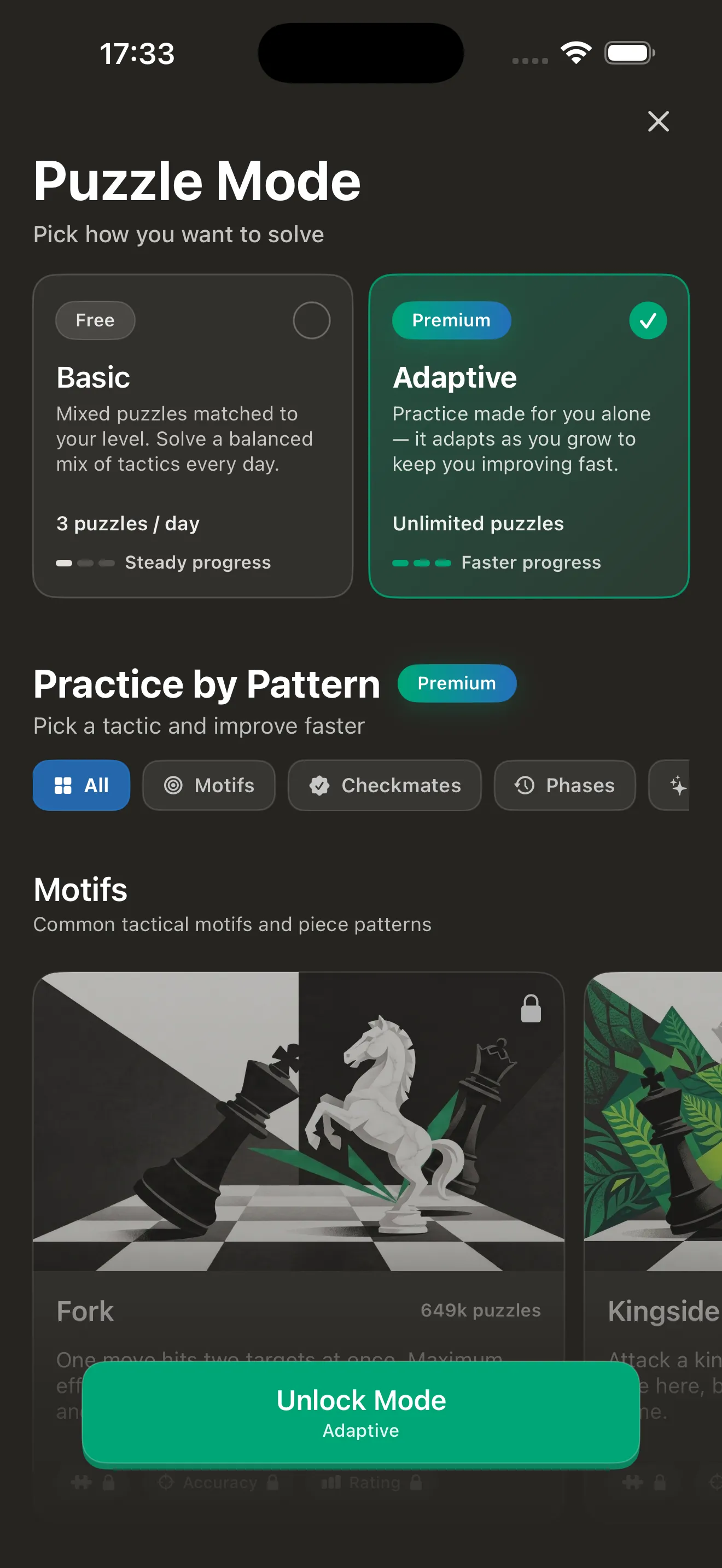
The main mode is Adaptive. It sizes up your rating from a quick quiz and your first handful of solves, then serves puzzles pitched right at that level. The library behind it holds over five million, so it doesn’t run dry at your rating the way smaller apps do. Win a few in a row and it quietly turns the screws. Miss a couple and it eases off. Prefer to drive yourself? There are five manual steps, from −300 to +300 rating points. The scale itself runs 400 to 2700, so it works whether you learned the moves last month or you’re chasing a title.
Not sure what your “right level” even is? I went deep on that in how puzzle ratings work.
Drill the exact pattern you keep missing
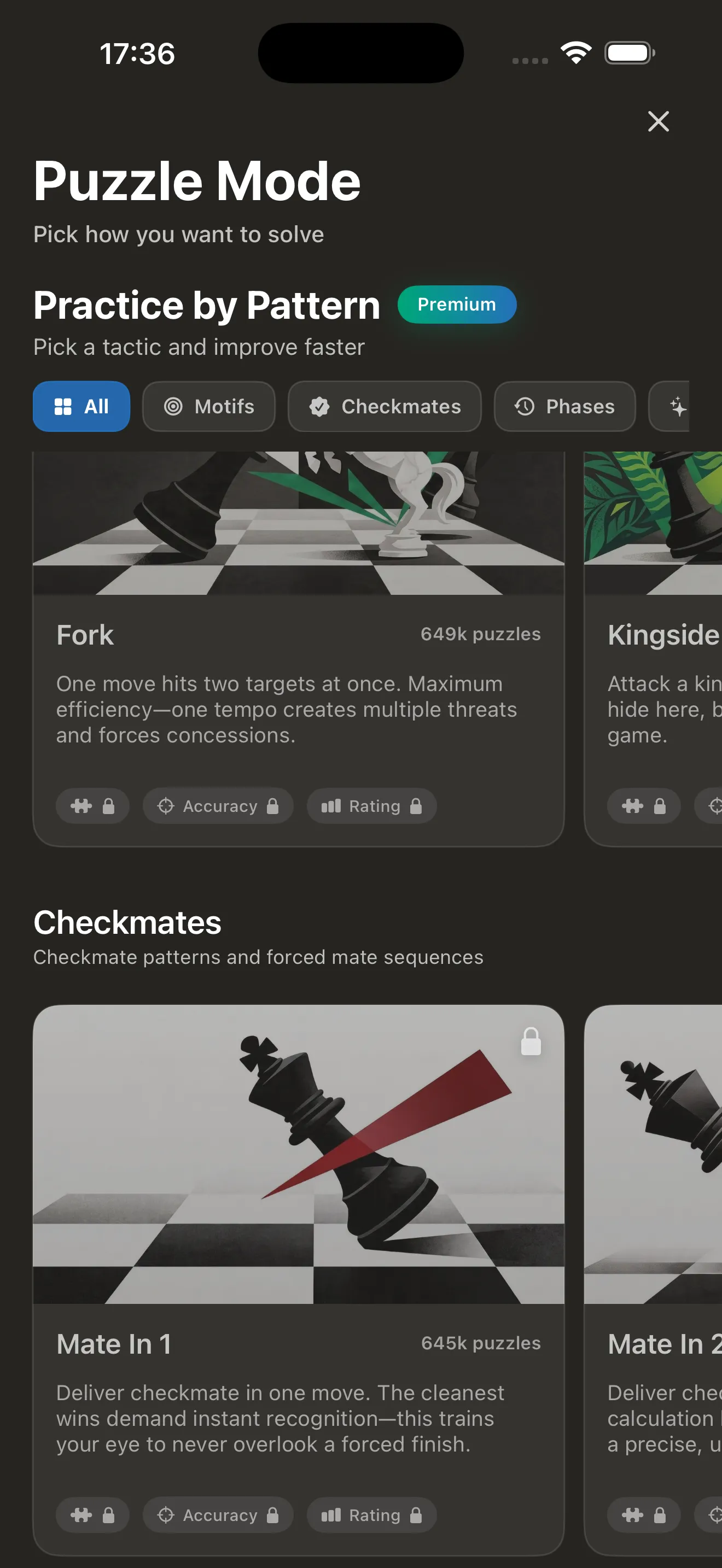
This is my favourite part, and the one I’d defend hardest in an argument. Practice by Pattern carves tactics into 62 themes across motifs, mates, and endgames. Forks alone have 649,000 puzzles. There are pins, skewers, discovered attacks, mate-in-1 through mate-in-five, back-rank and smothered mates, sacrifices, deflection, zugzwang, the lot. Every theme keeps its own accuracy score, which matters more than it sounds: your weak spots stop hiding behind a respectable overall percentage. You can poke around the whole pattern library right here on the site before you download a thing.
It tells you why you were wrong
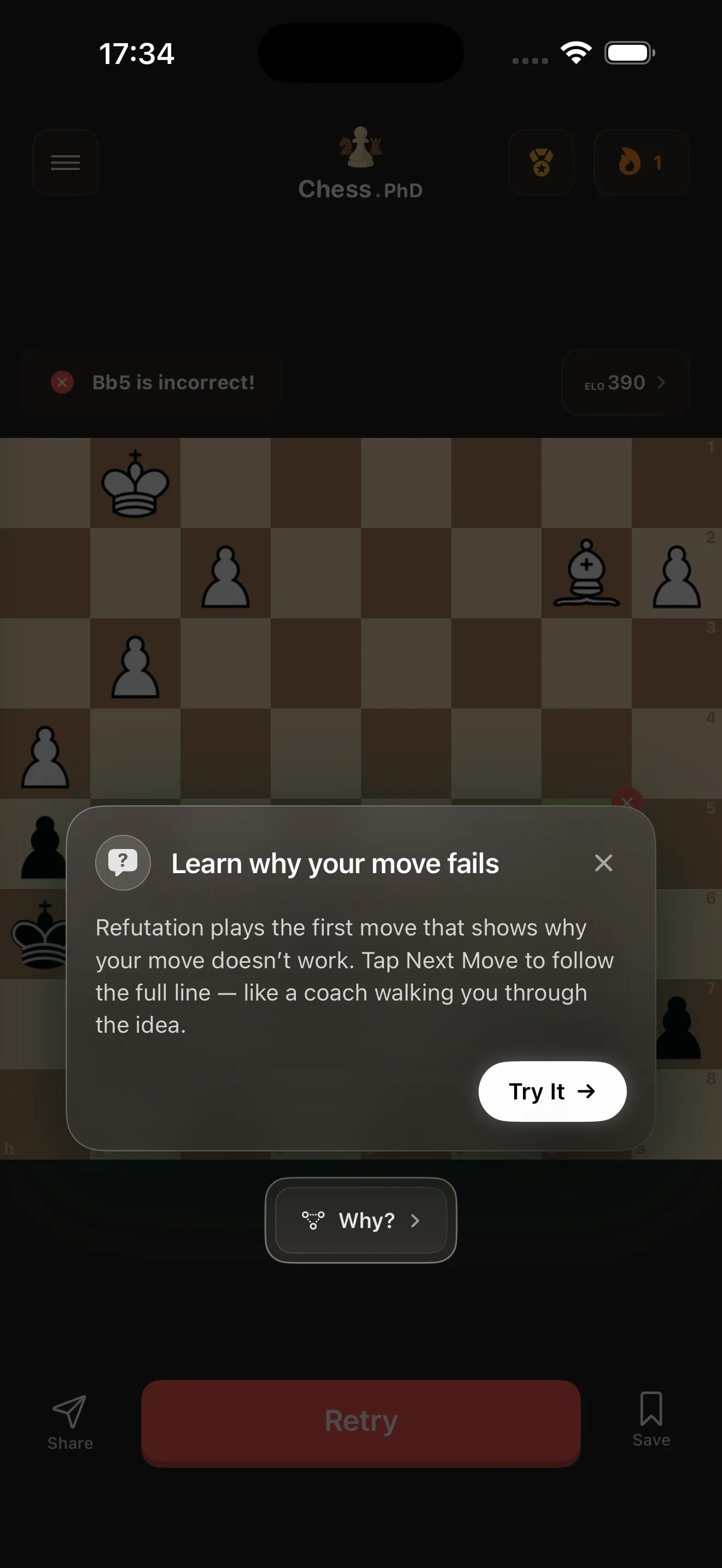
This is the bit that turns a quiz into a coach. Play a losing move, tap “Why?”, and the app plays out the refutation, the exact line that punishes what you just did, one move at a time. Solve it cleanly instead and you can step through the best continuation. All of it runs on a full Stockfish engine that lives inside the app, not off on some server. So the analysis, the refutations, the little coaching notes on each puzzle keep working with the phone completely offline. On a train, on a flight, in a café with rubbish wifi. Try getting that out of a puzzle tab stapled to a playing app. And if you blunder a lot (most of us do), “Why?” is easily the most useful button on the screen. There’s a whole guide to blundering less if that’s your leak.
A rating that doesn’t flatter you
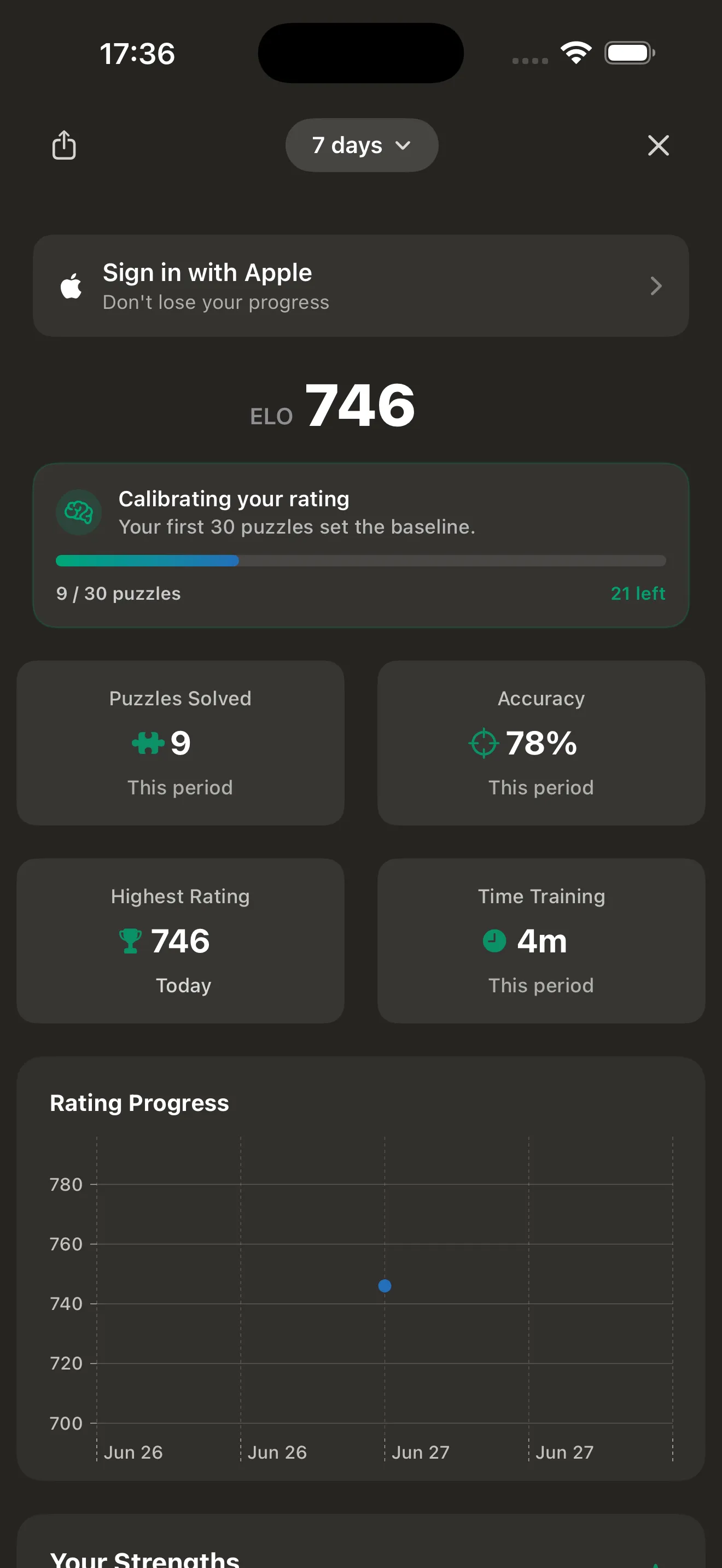
Your first thirty puzzles set a real ELO. After that there’s a proper stats page: accuracy, puzzles solved, minutes trained, a rating line over the last week or month, and a Strengths-versus-Growth-Areas split that more or less hands you your homework. There’s a rank ladder from Pawn up to King, and a daily streak with a couple of freezes so one miserable Tuesday doesn’t torch a month of work. Sign in with Apple and the whole lot follows you to your other devices.
It feels right on iPhone and iPad
Small thing, big thing. It’s fast, it’s clean, dark mode is actually dark, you can drag or tap your moves, it speaks four languages, and it runs on iPhone and iPad both. Offline it keeps around a hundred puzzles cached with the engine still live. And when a position nags at you, one tap exports it with the FEN preloaded so you can dig into it wherever you like. No sign-up wall to get going, no clutter.
Why a specialist beats a puzzle tab
If what you mostly want is to play games, play them wherever you already play. That is a different job and a big playing platform does it well. But a puzzle section inside a playing app is one room in a very large house, and it gets the attention a spare room gets.
Chess.PhD only has the one room and has spent all its time on it. The calibration, the per-pattern breakdown, the engine that runs offline and explains your mistake, the honest rating: every piece aimed at the same job. For tactics work on a phone, a specialist beats a generalist. That is the argument, and you can test it in a week.
How to start (it’s free to try)
Search for Chess Puzzles: Tactics Trainer on the App Store, answer a few quick questions so it can guess your rating, and start solving. It’s free to get going, and a subscription opens up unlimited puzzles plus the full engine. The routine that actually works is dull: a small set most days, hard enough that you get some wrong, and then reading the refutation when you do. That last part is the one everyone skips. If you want the method and not just the app, how to get better at chess tactics and how many puzzles a day are where I’d start. And if you want to see how it stacks up against the web platforms rather than the App Store, I put the main tactics trainers side by side.
The best puzzle app isn’t the one with the prettiest board or the biggest number on the box. It’s the one that pushes you a little, in the right direction, and that you’ll actually bother opening again tomorrow. That’s the one I set out to build. Give it a week, keep half an eye on your worst pattern, and see what the rating does after that.