
Light square in the right-hand corner, pieces on the first two ranks, and White plays first. That is the whole of the preparation, and the corner matters: get the board round the wrong way and every diagram you ever see will look mirrored to you. Each of the 64 squares has a name, a file letter then a rank number, and it is always that way round: e4, never 4e.


 8
8  7
7  2
2  a
a  b
b  c
c  d
d  e f g h 1
 The order below is the order I teach it in, and it has not changed in fifteen years of coaching. If the board itself is the bit you are stuck on, setting up a chess board has its own page, and so do the names of the pieces.
What you are actually trying to do
Not capture everything. The target is the enemy king, and only the king.
When one of your pieces attacks the enemy king, the king is in check, and the other player must deal with it that same move. There are exactly three answers: move the king to a safe square, capture the piece giving check, or put something in the way of the line. When none of the three exists, that is checkmate and the game stops right there. Article 1.2 of the FIDE Laws says it in one sentence, and the rest of chess hangs off it.
Here is the one I see most often at club level, and it takes a single move.
7 2 e g Now the trap on the other side of it. If the player to move has no legal move at all and is not in check, nobody wins. That is stalemate, and it is a draw. You are not allowed to sit a turn out either. There is no passing in chess, which is exactly why a player with nothing legal left to play draws instead of losing.
Draws are commoner than beginners expect. Stalemate, the same position three times over (Article 9.2), fifty moves with no capture and no pawn move (Article 9.3), too little material left for anyone to mate with, or the two players just shaking hands on it. Every one of those, plus resignation and running out of time, is listed on how a chess game ends.
The six pieces, one paragraph each
The pawn goes forward one square, or two on its first move only, and it captures diagonally forward one square. So a pawn on e2 can go to e3 or e4, and can take something standing on d3 or f3, but it can never take the piece directly in front of it and it can never go backwards. Reach the eighth rank and it becomes a queen, or whatever else you ask for.
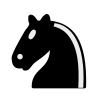
The knight jumps in an L: two squares one way, one square across. From g1 it reaches e2, f3 and h3, and nothing in between matters, because the knight is the only piece that goes over other pieces. From a corner it has two squares; from the middle of the board it has eight. That is why knights belong in the centre.
The bishop travels any distance on diagonals and never changes the colour it started on. Your c1 bishop lives on dark squares for the whole game. Your f1 bishop lives on light ones. Keeping both is genuinely useful, which is why players talk about the bishop pair.
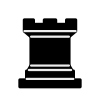
The rook travels any distance along ranks and files. It is worth five pawns and it wants open lines: a rook on e1 with no pawns on the e-file is looking at the whole board, and a rook shut behind its own pawns is doing nothing.
The queen does everything the rook and bishop do, up to twenty-seven squares from the centre of an empty board. She is worth about nine pawns, which is also why bringing her out on move two is a bad idea: every enemy knight and bishop develops with tempo by attacking her.
The king moves one square in any direction and may never step onto a square an enemy piece attacks. That single restriction is why a king can never capture the other king, and why the two kings always keep a square between them.
The three moves that break the pattern
Castling is the only move that shifts two pieces at once. The king goes two squares towards a rook and the rook hops over to the square the king crossed: e1 to g1 with the h1 rook landing on f1, or e1 to c1 with the a1 rook landing on d1. Five conditions, and beginners forget two of them. Neither the king nor that rook may have moved yet, the squares between them must be empty, the king must not be in check, and it may not pass over or land on a square the enemy attacks. The rook is allowed to be attacked; the king is not.
En passant is a pawn capture with a time limit. If your pawn is on the fifth rank (say e5) and an enemy pawn runs past it from d7 to d5 in one go, you may take that pawn as though it had only gone to d6, playing exd6 and lifting the d5 pawn off the board. You have to do it immediately. Wait a move and the right is gone for good. I lost a pawn and my temper to this rule in my first tournament, aged nine, and it is still the rule adults argue about most.
Promotion happens the instant a pawn reaches the far rank. Take it off and put down a queen, rook, bishop or knight of your colour, whether or not one has been captured. Two queens on the board is perfectly legal. A king is the only thing you cannot choose, and now and then a knight is the right answer instead, either because it forks something with check or because a new queen would be stalemate.
Your first game, in five habits
- Play 1.e4 or 1.d4. A centre pawn opens lines for a bishop and the queen at once.
- Knights before bishops, and get both out before move six.
- Castle by move ten. A king in the middle is the single commonest reason beginner games end early.
- Do not move the same piece twice in the opening unless something forces you to.
- Before every move, look at what your opponent just attacked. Then look at what is undefended on both sides.
Habit five is worth the other four put together. Most games under 1200 are decided by a piece left hanging, not by anything clever, and there is a whole post on how to stop blundering that goes through the checklist properly.
When you can play a full game without an illegal move, the next thing to learn is how to finish one: how to checkmate covers the two endings (queen and king, rook and king) that turn a winning position into a point, and mate-in-one puzzles will train your eye faster than any amount of reading.