

Three pieces. A white king on c2, a white pawn on g7, a black king alone in the corner on a1. White to play and mate in two.
You promote, obviously. 1.g8=Q, and then you look at the board and there is nothing to look at. Black has no legal move and is not in check. Stalemate. You had a queen, a king and an entire empty board, and you drew against a bare king.
The move is 1.g8=R. A rook, deliberately, because a rook is worse and worse is exactly what the position needs. The rook leaves a2 open, Black is obliged to play 1…Ka2, and 2.Ra8 is mate.


 a
a That is a chess problem. If the answer irritated you slightly, if some part of you objected that nobody promotes to a rook, then you have understood the genre exactly.
What a chess problem actually is
A chess problem, also called a chess composition, is a position somebody built on purpose. Nobody played it. A composer arranged the pieces to make one specific idea happen, then published it with a stipulation attached: mate in two, mate in three, mate in seven.
Three things come with that stipulation, and they are what separate a problem from everything else you solve:
The mate length is a promise. “Mate in 2” does not mean “White is winning and probably mates soon”. It means there is a forced mate on move two against any defence, and there is no forced mate on move one.
The first move is unique. Composers call it the key. If a second first move also mates in time, the problem is cooked: broken, withdrawn, an embarrassment. Soundness is not a nice-to-have in this form, it is the whole contract.
The solution is not one move. It is the key plus White’s answer to everything Black can try. A problem with six black defences has six variations, and you have not solved it until you can produce all six.
The form is old. Its ancestors are the Arabic mansūbāt of the 9th to 11th centuries, positions circulated as tests of skill long before modern chess rules settled. It took its current shape in the 19th century, when composition tourneys started running, awards started being printed under the diagrams (1st Prize, 2nd Honourable Mention, 3rd Commendation), and composers like Sam Loyd turned the problem into a genuinely popular form. It still runs that way. There is a world body, there are titled composers and titled solvers, and there is a World Chess Solving Championship where people sit in silence with paper diagrams for hours.
Chess problems vs chess puzzles
The words get used interchangeably and they should not be. What most apps call a chess puzzle is a position from a real game, cut at the moment where a tactic exists, verified by an engine. What a problemist calls a chess problem is something else.
| Tactics puzzle | Chess problem | |
|---|---|---|
| Origin | A real game, usually a database of millions | Composed by a person, for this idea |
| The task | Find the best move | Mate in exactly the promised number of moves |
| Correct answer | Whatever the engine prefers | The one key move, and nothing else |
| Solved means | You played the winning move | You answered every defence Black has |
| Position looks like | A game | Often nothing like a game |
| First move is usually | A check, a capture, a threat | Quiet. Frequently the last move you would consider |
The last row is where the training value hides, and we will come back to it.
The types of chess problem
Most solvers meet direct mates and stop there, which is fair enough, since they are the largest family by a distance. But the stipulation line can ask for stranger things.
Direct mate (#n). White moves first and forces mate in n. Everything above applies. A mate in 1 is a beginner’s exercise; a mate in 2 is the classical form and where most composition art lives; mate in 3, mate in 4 and longer problems shift the emphasis from a single brilliant key to a whole scheme.
Helpmate (h#n). Black moves first and helps. Both sides cooperate to checkmate Black as fast as possible. There is no opponent to outwit, only a construction to find, and helpmates produce mating pictures no real game would ever reach.
Selfmate (s#n). White forces Black to checkmate the white king, against Black’s will. Black spends the whole problem trying not to mate, and White compels it anyway. It reads like a typo the first time you see it and it is one of the sharpest tests of calculation there is.
Reflexmate (r#n). A selfmate with an added rule: whichever side can mate in one must. Rare, and delightful once it clicks.
Study (+ or =). An endgame composition. Instead of a move count you get a result to prove: White to play and win, or White to play and draw. Studies sit closest to practical chess, which is why endgame books are full of them.
Here is the split in the collection we assembled for the app, which gives a fair picture of how the published literature is actually distributed:
| Genre | Notation | Problems |
|---|---|---|
| Direct mate | #2, #3, #4… | 370,786 |
| Helpmate | h#2, h#3… | 67,342 |
| Selfmate | s#3, s#4… | 40,095 |
| Study | +, = | 4,645 |
| Reflexmate | r#2… | 908 |
Nearly eight in ten are direct mates, and inside that group the two-mover dominates everything else. That is not an accident of collection: the mate in 2 is to problem composition roughly what the sonnet is to poetry, a form tight enough that the constraint does the work.
The words problemists use
The vocabulary is small and worth twenty minutes, because it turns solving from guesswork into a procedure.
Key. White’s first move. Unique, by definition, in a sound problem.
Try. A first move that almost works. It defeats every black defence but one. Tries are content, not accidents: composers build them in so that the solver’s plausible ideas get punished in instructive ways.
Refutation. The single black move that kills a try. When you play a wrong first move in a good problem, there is exactly one answer that shows you why, and finding it is half the education.
Threat. What White intends to play next if Black does nothing. Most keys carry a threat; the elegant ones do not, and instead leave Black in zugzwang.
Variation. The key, one black defence, and White’s mate. A problem’s real content is the set of its variations.
Dual. Two different White moves that both mate in a given variation. Minor duals are tolerated, but a composer would rather not have them.
Cook. A second key. Fatal. The problem is unsound and gets withdrawn.
Zugzwang. Black would be fine if he could pass, but he must move, and every move breaks something. The engine of an enormous proportion of two-movers.
Miniature. A problem with seven pieces or fewer. Elegance under a piece budget.
Model mate. A mate where every square around the black king is either blocked by one of Black’s own men or guarded exactly once, and every white piece bar the king and pawns plays a part. The aesthetic ideal, and considerably harder to build than it sounds.
Every line the composer meant
Here is the part that changes how you solve, and the part most people skip.
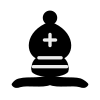
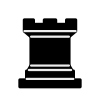
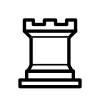
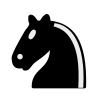
Take this two-mover. Give it a few minutes before you open the answer. It is a fair problem, and it is findable the moment you stop looking at the pieces that appear to be doing something.
 8
8 

 d
d Show the key
1.Ke7. The white king steps sideways. No check, no capture, no visible threat.
The key is 1.Ke7, and it is a king move: it gives no check, takes nothing, and threatens nothing you can see at a glance. It is also the only move in the position that mates in two. Everything else fails somewhere, and there are plenty of candidates that look far more purposeful.
Now count. After 1.Ke7 Black has twenty-four legal moves, and White mates against every single one of them. But twenty-four variations is not what the composer built. Five of those defences are the problem; the rest are filler that gets mopped up. Here are the five:
| Black’s defence | White’s mate | What Black did to himself |
|---|---|---|
| 1…fxe2 | 2.Qh1# | The f3 pawn steps off the h1-e4 diagonal and opens the queen’s road to e4 |
| 1…Rxb3 | 2.Qxe5# | The b5 rook grabs the knight and stops guarding its own rook on e5 |
| 1…Rec5 | 2.Qd4# | The e5 rook leaves the long diagonal, and the queen arrives on d4 |
| 1…Red5 | 2.Nd2# | Same rook, different square, and now a knight does the work |
| 1…Bd5+ | 2.Qxe5# | Discovered check from the e5 rook, answered by capturing the checker, with mate |
Look at that last line for a second. Black’s defence gives check. White is in check and mates anyway, by taking the piece that is checking him. That is not the kind of move that turns up in your calculation by accident.
And look at the pattern across all five. Every one of Black’s defences is the cause of its own mate. The f-pawn defends by capturing and unblocks a diagonal. The rook defends by taking a knight and abandons a square. The bishop defends and opens a file behind itself. This is what composers mean by content, and it is invisible if you stop at the key.
So here is the rule. Finding 1.Ke7 is not solving this problem. It is finding the key. You have solved it when you can produce a mate against every defence the composer wrote down, when there is no black move that makes you pause.
That distinction is why solving a problem properly takes ten minutes and “getting” it takes ninety seconds. It is also why we built the board in Chess.PhD to enforce it. Play the key and the board does not congratulate you; it plays Black’s first defence and waits. Mate that line, and it rewinds to the branch point and plays the next one. The problem is not solved until every branch is closed. A mate in 3 with seven defences is seven separate mating pictures you have to see, and the position on the board when you finish is not the position you started calculating from.
The same machinery handles wrong moves. Play a plausible first move that happens to be one of the composer’s tries, and instead of a red cross the board plays Black’s refutation on top of it and leaves both moves standing, so you can look at the position that beat you. Play something that mates in three when you were asked for two and it says so, because “too slow” is a different mistake from “wrong”.
How to solve a mate in 2
The order matters more than you would think, and it is not the order most players use.
Build the mate before you go looking for the move. Where is the black king, which squares does it actually have, and what would have to be true for it to be mated where it stands? At this stage you are not hunting for a good move at all. You are assembling a picture, and the move comes later, once you know what you are trying to produce.
Next, ask what happens if Black simply has to move right now. Set your own ideas aside and pretend it is Black’s turn in the position as it stands. If several black moves already walk into a mate, you are almost certainly looking at a zugzwang problem, and the key’s job is to preserve that state of affairs without disturbing it. Usually that means a waiting move somewhere quiet, on the other side of the board from everything interesting.
Then distrust every check and every capture. Composers know checks are the first thing you look at, and they know that you know. A key that gives check is rare. A key that hands the black king a new flight square is a hallmark of a good problem, precisely because it is the hardest move on the board for a solver to take seriously.
Which brings you to the ugly moves. King moves, retreats, underpromotions, a rook shuffling into a corner. If you have been through everything sensible and nothing works, the answer is sitting in the pile you dismissed in the first thirty seconds. That is exactly where composers put it, because that is where you are not looking.
And then do the actual work. Take your candidate key and walk through every black reply. Every one of them. The move you skip is the refutation, which is close to a law, and it happens to be the same law that costs you games on a Tuesday evening.
For a mate in 3 the shape changes slightly. Three-movers are usually about a scheme rather than a single trick: White’s second move is often the real point, and the key exists to set it up. Longer problems, mate in 4 and beyond, tend to run on manoeuvres: a piece has to reach a square and there is only one route that does not give Black a tempo.
Why solving problems sharpens your tactical vision
Now the practical question, since most people reading this play actual games. Does any of this make you stronger?
Yes, in two specific ways, and it is worth being precise about which.
It builds the habit of checking every reply. This is the big one. Almost every tactic you miss in a real game is not a tactic you could not calculate. It is one you never looked at. You found a move that worked, you stopped, and the move you did not examine was the one that mattered. Problems attack that habit directly, because a problem is not solved until every defence is answered. Ten minutes on a two-mover with six variations is ten minutes of not being allowed to stop early. Nothing else in chess training enforces that as bluntly.
It expands what counts as a candidate move. Club players have a narrow candidate list and mostly do not know it. Checks, captures, threats, developing moves. Meanwhile the tactic sitting in the position is a bishop retreat, and it never enters the search at all. Composed problems live in exactly that territory. The quiet key, the king step, the rook underpromotion: solve a few hundred of them and those moves stop being invisible.
That second effect shows up in real games faster than you would expect. Here is a position from a real game, rated 802, which is to say not hard. White is dead lost: Black has a queen on e1, a rook, a knight and a winning position. White to play and mate in one.
5 4 2  e
e Show the solution
1.f8=N#. A knight, and only a knight. It is the one mate in the position.
The knight checks the king on g6, the rook on b7 takes away f7, g7 and h7, the bishop on g5 covers f6 and h6, and the h4 pawn means the bishop cannot be taken. Promote to a queen instead and there is no check on the board at all; Black has thirty-nine legal moves and a game he wins.
Different motif from the three-piece problem we opened with, same reflex: the promotion square wanted something that was not a queen. A solver who has met a few dozen underpromotions in composed problems checks the knight automatically. Everyone else queens, because that is what you do.
Two honest caveats. Problems will not fix your openings, your endgame technique or your clock. And the positions genuinely are unlike game positions, and a diet of nothing but two-movers is not a training plan. Use them the way you would use scales: alongside the game-like tactics that make up the bulk of the work, not instead of them. Two or three problems a day next to your normal puzzle volume is about the right ratio.
Over 300,000 chess problems in Chess.PhD
We recently shipped Problems as its own mode in Chess Puzzles: Tactics Trainer, and the size of it is worth explaining, because “300,000” is a number that could mean almost anything.
It means over 300,000 direct mates, from two-movers up to problems eight moves deep, drawn from the published composition literature of the last two centuries. Roughly 6.9 million solution lines in total, with more than 19,000 named composers behind them and around 162,000 problems carrying a tourney award.
Every one of those lines was verified by machine before it went anywhere near the app. Each move of each branch was replayed from the starting position and checked: is it legal, does the notation resolve to exactly one move, and where the source claims mate, is it mate on the board. Anything whose printed solution could not be reproduced move for move was rejected rather than shipped. So were problems with more than one working first move, 8,263 of them or about 2.7%, because a position with two keys cannot tell you whether your answer was right, and a puzzle that cannot mark itself is not a puzzle.
The problems are organised into thirteen collections rather than one undifferentiated pile.
Start here is the one to open first: 464 two-movers with four pieces or fewer. Few pieces does not mean easy. At that size White has no useful checks at all, so the key is nearly always a quiet move, a zugzwang or an underpromotion, and the very first problem you see teaches you what the genre is really about.
After that the corpus is cut by depth, which is how most solvers want to work: mate in 2, mate in 3, mate in 4, and everything from five moves upward. There are three collections of problems that won something, covering first prizes, tourney works and awarded miniatures. And the rest slice by size, era and school: five-piece problems, two-movers of the 19th century, the golden age, the Soviet school, and modern long problems for anyone who wants to sit with one for an afternoon.
Inside a collection you can filter by piece count, mate length, era, award and whether you have already solved it. The board enforces every line, shows you the refutation when you fall for a try, and offers a hint that reveals the next move of the branch you are standing in rather than the whole answer. Solving without a hint and without a mistake is tracked separately, because on a problem the difference between those two matters.
Where to start
If you have never solved a composed problem, do not start with a prize-winning three-mover. Start with two-movers with almost nothing on the board. Five or six pieces, ten minutes each, and resist the answer button harder than feels reasonable.
Give yourself two rules from the beginning. Do not accept a key until you have a mate against every black reply. Write them down if it helps. And when you get one wrong, go and find the refutation of your move before you look at the solution, because that is where the actual lesson is.
Then, once two-movers stop surprising you, move to three. The jump is bigger than it looks, and it is the one that turns solving into calculation training rather than pattern recognition.
If you want the whole thing in your pocket, Chess Puzzles: Tactics Trainer is free on iOS, and Problems ships with it, alongside five million game-derived chess puzzles and a pattern library covering everything from forks to zugzwang.
Fair warning, though. Composed problems are habit-forming in a way that ordinary puzzles are not, and the reason is that a good one does not just have an answer. It has a joke, and the joke is on you, and it is always the move you decided was ridiculous.